Stereochemistry
A carbon with four different groups attached has a mirror image it cannot be laid on top of. That geometric fact results in some organic molecules existing as stereoisomers, being named with R and S labels, and having important roles in both Chemistry and Biochemistry.
Morphine — asymmetrical. Open the 3-D model →
01Structure and isomerism
Symmetric or asymmetric?
Open the models below to convince yourself whether each one has symmetry (symmetric) or lacks symmetry (asymmetric). Count the different types of atom or group attached to the central sp³ carbon as you turn each model over.
- 2 different types of atom attached — symmetric (3-D model)
- 3 different types of atom attached — symmetric (3-D model)
- 4 different types of atom attached — asymmetric (3-D model)
The full IUPAC listing of the Cahn-Ingold-Prelog rules is found here.
02Enantiomers and non-superimposability
Mirror images that don’t match
In general, when an sp³ carbon has four different atoms or groups attached it is asymmetric. This leads to the possibility of an isomer that is the mirror image but not superimposable. These are enantiomers, examples of which are the stereoisomeric (R)- and (S)-2-butanols.
Move the models so they are facing each other through a mirror; they do not match if we try to put one on top of the other, so they are not the same molecule. The idea of non-superimposability is illustrated below; however we try to overlay the two molecules, they will not match.
03Spot the chiral centre
Practice before the rules
Rotate the following molecules and decide which are symmetrical and which contain an asymmetric carbon atom.
?Which molecule is asymmetric?
Only the second molecule is asymmetric, with a chiral centre.
04Cahn-Ingold-Prelog rules
Assigning R and S labels
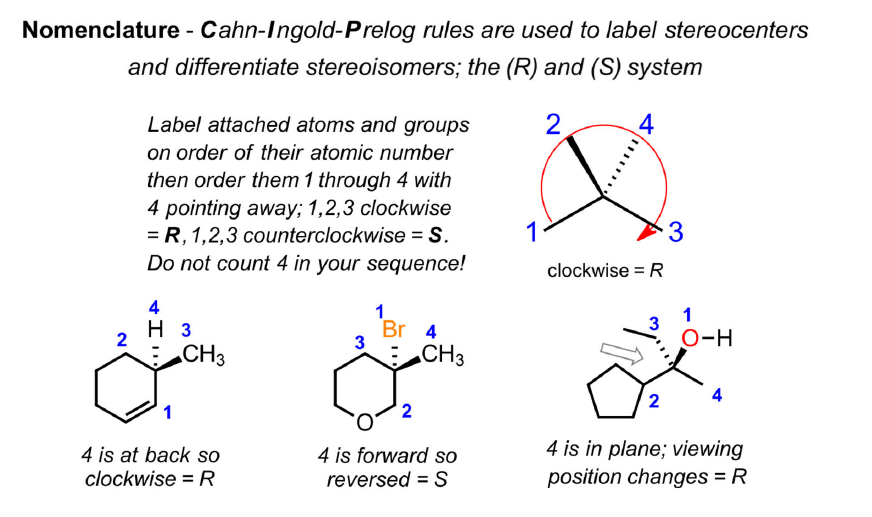
If we have two molecules, enantiomers, that only differ by their projection of groups into space, we need a naming system to differentiate them. This will be the Cahn-Ingold-Prelog (CIP) rules for designating configuration as either R or S.
05Fischer projections
Flattening a tetrahedron onto paper
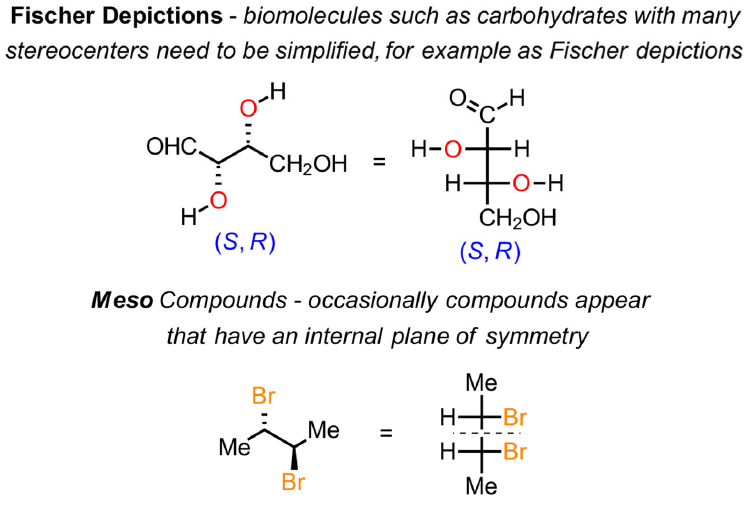
A Fischer projection draws the chiral centre as a cross: horizontal bonds come toward you, vertical bonds go away. It is a fast way to compare stereocentres in molecules with several of them, provided you remember what the two axes mean.
Six questions before you move on
Work out an answer on paper, then reveal to check. If your reason is right but the answer is wrong, you are closer than you think.
Q1What is the test for an asymmetric sp³ carbon?
Four different atoms or groups attached. With any two the same, the molecule has a mirror plane through that carbon and its mirror image is superimposable.
Q2Two structures are mirror images of each other. Does that make them enantiomers?
Only if they are also non-superimposable. A symmetric molecule has a mirror image too; it just happens to be the same molecule.
Q3In the CIP rules, how do you break a tie when the first atoms attached are the same?
Move out one bond at a time and compare the sets of atoms at the next sphere, highest atomic number first, until the first point of difference. Double bonds count as duplicated atoms.
Q4You have ranked the groups and read the rotation, but the lowest priority group points toward you. What now?
Read the rotation as drawn, then reverse it. Clockwise with the lowest priority in front is actually S.
Q5In a Fischer projection, which bonds come toward you?
The horizontal ones. Vertical bonds point away from the viewer, which is why rotating a Fischer projection by 90° inverts the configuration.
Q6Do (R)- and (S)-2-butanol differ in boiling point?
No. Enantiomers share every common physical property. They differ only in the direction they rotate plane-polarised light and in how they behave toward other chiral things: reagents, catalysts, receptors.